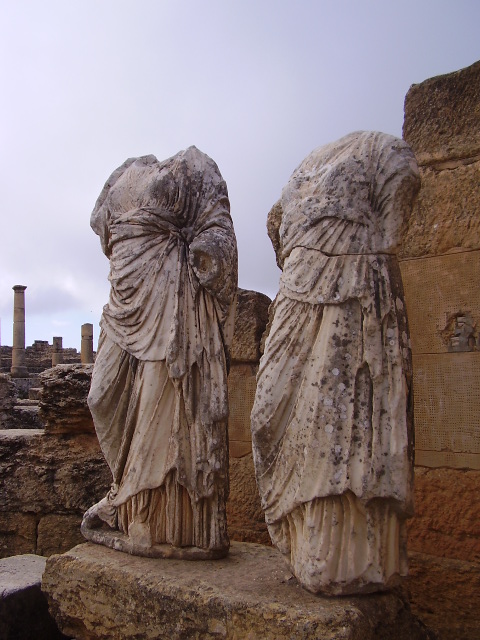
Reflections on remembrance rituals

Cyrene-Ancient Greek City-
in modern day Shahat-Eastern Libya…spending a few hours
remembering reflecting on our
forefathers in some such sites is a nice way to connect
with the larger whole of which we are all a part

The ritual of prayer has its healing powers. Many people pooh-pooh the religious rituals as they are done mindlessly. However if a ritual is done regularly with proper thought and  application, it builds  perspective. Remembering-reflecting rituals like Shraddha as observed by Hindus are an important part of the spiritual calendar.

Other traditions also have similar periods of fasting and remembrance

Values and beliefs

The fifteen days of Shraddha period-Sep 30 and October 15 are going on and it is a time when children remember their fathers and forefathers as per Hindu tradition. The value system of the family unit is fundamental to society and it is always important to nurture this sense in children. Belief systems may change as per social and scientific knowledge.

“Do you not believe in God” one long time friend of Christian faith once asked me on reading one of my articles- No More Gods.

“If you think of this whole universe as having been created by a supernatural being who is still controlling everything by remote control, I definitely do not believe in this,” I replied. Richard Dawkins book is a masterpiece on this and should be read by all those interested in clarifying their concepts on this.

Belief in the family system as per Hindu tradition still makes me observe the cultural calendar. In a few days the Navratras will start-which are going to be observed with much fanfare in many parts of the world. I go through the prayers during Shraddha period, remembering and reflecting on some of my forefathers.

What are the benefits of participating in ritual prayers and calendar events, in which at a regular time of the year, one remembers our forefathers and reflect on our family history and sense of being a part of a larger whole.

Family as Anchor

On a pilgrimage to their family home
Upper Kaithu Bazaar-Shimla-September 2012
Savitri-Surendra Thapliyal, Prity Dutta

Reflecting on the family system makes me use this
photograph of my aunt, in front of our family house in Shimla,
India where we used to stay in the later part of the 19th
century and first half of the previous century.

The family migrated from Srinagar Garhwal to Shimla in 1890s…
then to Delhi around 1940s..

It was a pilgrimage to Kaithu, a prayer at Kali Bari and
a walk down memory lane..the younger sister of my father,
Savitri Thapliyal was once a small school girl –
Savitri Bhatt, she visited her old school and other
memorable sites.. a walk down the Ridge in Shimla…
made me remember some of my own childhood visits to
the hills around Shimla..the walks down Lakad Bazaar,
the songs at Anandale, the prayers at the hill temples
of Jakhu and Taradevi..

Who we are? Genealogy is an important and interesting aspect of developing a sense of identity and context. This is also a time to reflect on the role of family system as an anchor to the many functions which a human being does, in different institutions which can only be supported by a family unit. It also gives a sense of continuity.

Part of a larger whole

Consciousness is beyond individual minds. When the part tries to contemplate the larger whole, the issues like senses, mind, various objects being part of a larger cosmos one gets a better perspective.

Acceptance versus resignation

In the African tradition, people celebrate death as much as a part of life process as death. This is different from Judeo-Christian traditions. The African tradition deals with the spirits of those who passed away as friends in contradistinction to some other traditions in which ghosts and spirits have a negative connotation.

“It is God’s wish” I hear many people say in resignation when faced with sad news.

“This is life” is another oft-repeated sigh which I hear.

There is an undertone of resignation in these expressions.

Connecting with the spirits, the positive legacy of those who shared some precious moments of life with us, shaping our values and beliefs, nurturing us in our formative years, giving us a base and platform to develop, nudging us when we were a bit down and still remain a living reality in every breath of ours is a positive way of accepting that life is a process of continuity. The movie Saaransh ends with the father seeing some saplings grow and expresses in realization- (roughly paraphrased)- “I Have an end, you have an end-but life does not end..”

Accepting the processes of birth and death and celebrating life in all its shades and nuances is something I developed through observing the remembrance-reflecting rituals as observed during the “Shraddha-Periods” of Hindus.

* * *

Do you have an experience of the sense of continuity one gets when remembering and reflecting one’s forefathers?

–          –

In next article we will reflect on the sense of Legacy, Nostalgia and Catharsis which one gets by participating in remembering-reflecting rituals. Other traditions also have similar periods of fasting and remembrance.

Posted in Diary, Learning, life | Tagged , , , , , | 1 Comment

Revisiting perspectives on Gandhi Jayanti

October 2-the birthday of Mohandas Karamchand Gandhi

(Born Oct 2,1869 ,died Jan 30,1948 ) was an occasion

to reflect on some Non-Western Anarchisms.

In his article “Contemporary Anarchism” Eric Kerl writes

about the wide breadth of ideas often contradictory which

fall under the umbrella of Anarchism. It is not uncommon

for people for such as Max Stirner, Leo Tolstoy, Henry

David Thoreau, Michael Bakunin, Emma Goldman, or even

Gandhi to be included in the broad tradition of anarchism.

Is Anarchism relevant in the post-Gaddafi turmoil of Libya

today.

We examine this by taking note of some conversations

which will probably help to create a meta-language

of sensitivity and help guide the discussion beyond

mindless violence.

1. Thinking with the Worker

2. Thinking with the patient, and issues of medical insurance

3. Thinking on the revenge mentality-will it lead to justice or peace?

4. Reflecting on Tolstoy’s definition of Murderer

5. Creative possibilities by having democracy based on non-violence

Non Western Traditions of Anarchism

Anarchism finds its first and most well-known expression in India

with Mahatma Gandhi’s statement, ‘the state evil is not the

cause but the effect of social evil, just as the sea-waves are

the effect not the cause of the storm. The only way of curing

the disease is by removing the cause itself…the state is perfect

and non-violent where the people are governed the least.

The nearest approach to purest anarchy would be a democracy

based on non-violence. ”

Jason Adams, Non Western Anarchisms: Rethinking the Global

context (Soweto:South Africa:Zabalza Books, 2003)

(Source-http://www.isreview.org/issues/72/feat-anarchism.shtml)

Thinking with the worker

“My wife is working in the health sector. Earlier I had a job in the

construction sector but now my company has closed and I am

looking for a job,” a friend from India told.

He has started a selling cheap international phone cards to

sustain himself.

“Do you think you are very capable?

We will find someone to replace you.”

When the Philippino staff nurse asked the director why he was

being so harsh when all she was asking for was a visa to visit

her family, he backed out- I was just joking.

Such insensitivity towards someone who stayed with them

throughout the civil war is not uncommon.

Thinking with the patient

Last month Bupa international, the leading international health

insurance provider, and Sahara Insurance Company,

announced joining forces to provide international private

medical insurance plans for organizations based in Libya. (1)

While corporates linked with oil and government agencies get

insurance a large number of Libyans go without proper health insurance.

“I work and deposit my money in the bank.

I do not get insurance, the banker and his family gets it, Why?”

Medical workers without Medical Insurance

Do you have insurance?

When I asked this to several foreign workers in private medical clinics,

they answered

“Ironically, though we work in clinics where many patients come

through insurance providers like BUPA the workers in these very

institutions have no medical insurance.”

In places like Dubai it is mandatory for the employer to provide

medical insurance to the workers. This is not so in Libya.

Need for Restorative justice

The discourse of justice being interpreted as revenge will have

to be re-thought out in creative ways, while keeping the moral

compass in present day Libya.

“ We do not want to stretch this further.

But if we will be persecuted, we  have no option,”

Democracy based on nonviolence and modeling a

“ Truth and Reconciliation Commission” like in South Africa

http://en.wikipedia.org/wiki/Truth_and_Reconciliation_Commission_(South_Africa)

Will help healing better.

“But what about Justice” comes an alternative opinion.

“There can be no closure without justice.”

The debates continue.

Democracy based on Non-violence

Tolstoy’s doctrine of “Non-resistance to evil” influenced Gandhi

and introduced “Soul-Force” into human history, thus changing

the course of humanity.

As one muses on the themes of spirit of this revolution,

the means and what it means for the workers on the ground,

a revisiting of some previous thoughts will help perspective

In “ One year on, what is the change”

https://prashantbhatt.com/2012/02/19/one-year-on-what-is-the-change/

we revised the meaning of “Murderer”

Was wondering about this meaning of “Murderer” as

asked by Count Leo Tolstoy


In another pamphlet, entitled “How many Men are Necessary to

Change a Crime into a Virtue?” he says:

“One man may not kill. If he kills a fellow-creature, he is a murderer.

If two, ten, a hundred men do so, they, too, are murderers.

But a government or a nation may kill as many men as it chooses,

and that will not be murder, but a great and noble action.

Only gather the people together on a large scale, and a battle

of ten thousand men becomes an innocent action.

But precisely how many people must there be to make it so?–

that is the question. One man cannot plunder and pillage,

but a whole nation can.

But precisely how many are needed to make it permissible?

Why is it that one man, ten, a hundred, may not break the

law of God, but a great number may?”

Tolstoy, Leo.The Kingdom of God is Within You.

* * *

Exploring the nature of finiteness, ego and evil on Gandhi Jayanti

made us revisit some meanings and definitions.

Talking to persons on the ground, workers,patients, common

citizens, some big-company representatives, some relatives

seeking cross-border care, and listening to news of increasing

intolerance, makes it even more pertinent to reflect

on the following words of Emma Goldman

“No revolution can ever succeed as a factor of liberation

unless the means used to further it be identical in spirit and

tendency with the purposes to be achieved.”

In these conversations we try to seek a common

language going beyond the rhetoric of revenge

and corporates to real issues of people.

Notes and suggested further reading:

http://www.isreview.org/issues/72/feat-anarchism.shtml

http://www.libyaherald.com/?p=14686

http://www.suffolk.edu/research/6953.html

Other posts of interest

Which Historiography: In search of the unknown worker

https://prashantbhatt.com/2012/05/31/which-historiography-in-search-of-the-unknown-worker/

The Eight hour day-Remembering Hay market in Tripoli

https://prashantbhatt.com/2012/05/01/the-eight-hour-day-remembering-hay-market-in-tripoli/

Remembering Studs Terkel-I want to conserve the blue of the skies.

https://prashantbhatt.com/2012/05/18/remembering-studs-terkel-i-want-to-conserve-the-blue-of-the-skies/

Reflections on our Republic Day

https://prashantbhatt.com/2012/01/27/reflections-on-our-republic-day/


Posted in Arab Spring-Libya, Learning, life | Tagged , , , , , , , , | Leave a comment

Letters..windows to other worlds

A letter still remains one of the most lasting methods of staying connected. The intimacy of spoken word is different from that of the written word.

The discussion on Skype Parenting https://prashantbhatt.com/2012/09/11/skype-parenting/reminded me of the letters and first day covers my father used to send to me from Nagaland, India around 1980. There was no skype then.

I was initiated into the art of letter writing by my maternal grandfather who used to correct my letters and send them back with suggestions, from Moscow in the mid 1970s.

Those impressions have stayed with me.

Dr.Jose raised some interesting points about curriculum in our schools, but the issue here of connection through joint journals, family journals, photo-archives, school newsletters was to get a window into the family life.

One of the most lasting impressions which I have had were the letters, first day covers and corrections I used to get from my father and grandfather , in letters from Nagaland and Moscow.

Remembering Grandparents

September 9 was Grandparents day. How do you remember your grandparents? What is the family legacy as seen through this question?

“My grandfather and father used to not see eye-to-eye on many things. But my grandfather was deeply attached to me, and it was through me that he communicated with his son,” one expatriate worker said, remembering the family dynamics and also recalling how his grandfather could remember the distinctive marks of hundreds of sheep whom he took for grazing in the fields of Maharashtra.

https://prashantbhatt.com/2012/03/10/remembering-grandfathers/

Letters- Windows and perspectives

A letter written from another place, makes one visualize a larger reality making us form perspectives and visions of worlds and ways of life other than one’s own.

The art of letter writing in the 18th century assumed an interesting form. It produced gossipy letters on things in general or political squibs. By means of this light, discursive literature, we have a steady flow of illuminating gossip on the life of the time, highly valuable to the social historian.

What are the types of letters which can be written to one’s children?

What are the letters which they can write back?


Of different worlds-

A life of one’s own: While being connected the child should realize that the parent who is living away has a life of his/her own, has work, friends, places to go and interact with. These windows can give interesting insights and also when they meet, they will have a common ground to discuss and talk about.

Moscow life- My grandfather would describe about life in the former USSR.How the different family dynamics were affected by his staying away from his home country. The institutions which he interacted with and the way these affected him.

This gave me an idea as a child about way institutions are developed in different societies.

As I matured I realized the differences and similarities between Nehruvian India’s institutions-be they educational or scientific and the institutions built in societies transitioning under different forms of socialism.

Nagaland Life – The butterflies and first day covers which my father would send from Nagaland provided us with a window into a part of the country which we would not see. Again, the way the Armed forces builds a sense of nation but also divides it came to my mind as I thought of the Nagaland letters of my father.

He wrote to me of the Kohima war memorial and the sacrifices on that front in World War II.

The natural surroundings of the hills of Kohima, institutions and how they interact and what the local population feels about them, life away from home and the visits back, all went into giving windows into a way of life which have formed impressions and a baseline to reflect upon later in life.

* * *

In coming blogs we will discuss other types of letters with different focus, which help form perspectives. The Conversational letter. The Scientific letter. A review of a book or movie. An account of a place visited. An account of a family visit. An account of remembering some family member. See blog –Remembering Grandfathers.

Some people may call me old fashioned.

Those who belong to the skype generation may even not bother to read this far.

But I still believe in the power of the written word.

I feel letter writing remains an important part of parenting.

A letter still remains one of the most lasting method of staying connected. The intimacy of spoken word is different from that of the written word.

* * *

Do you remember a letter interaction which shaped your perspective?

Posted in Diary, Learning, life | Tagged , , , , , , , | 2 Comments