One year on, what is the change?

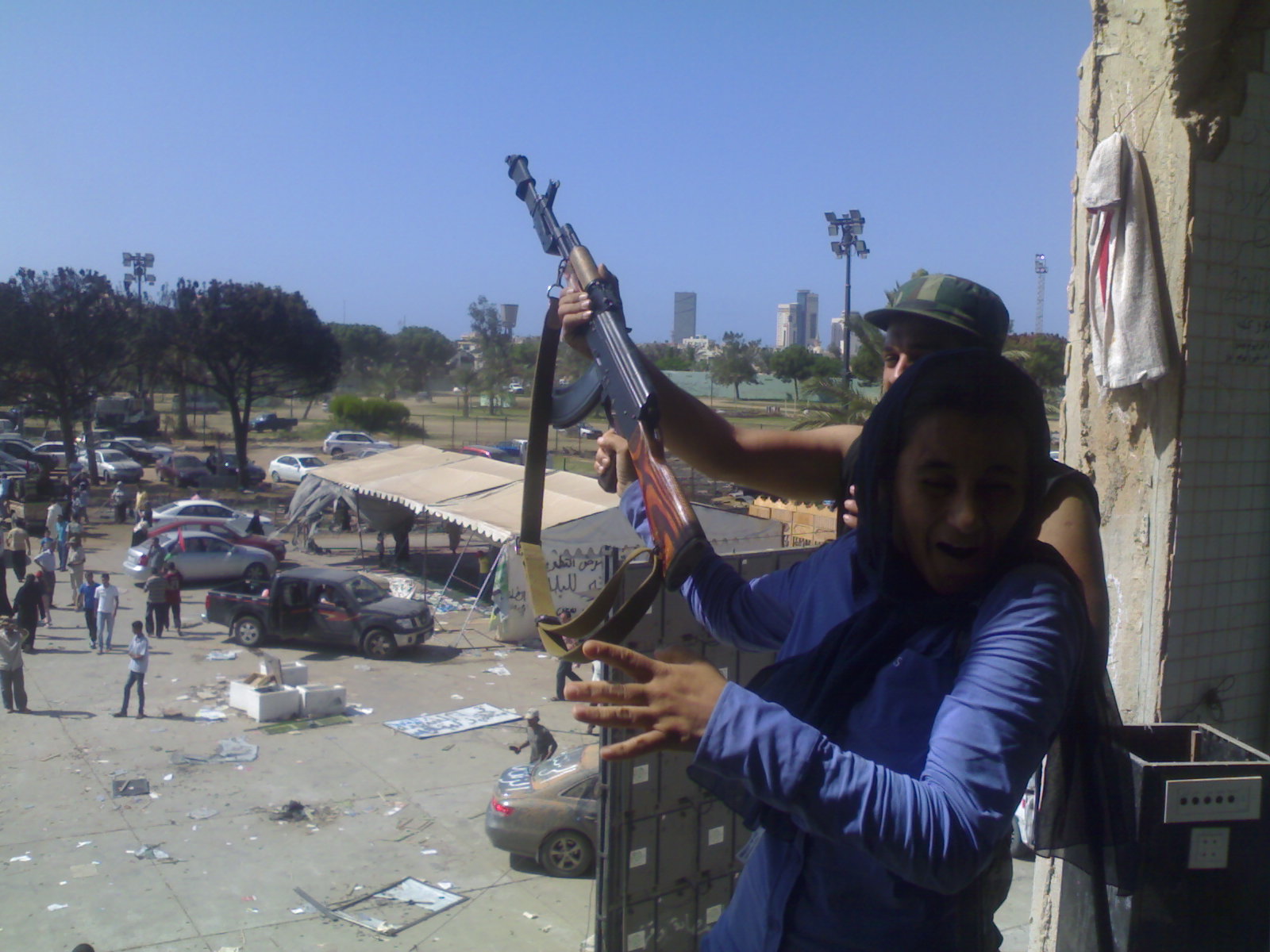
Thousands came out on the first anniversary of February 17 revolution of Libya , some armed, some just wearing the tricolor.

A family going for celebrations-Dahra

Are you dealing with the same persons?

A senior diplomat probed any real change in the hierarchy.

The Labour ministry officials are the same. However, they are not taking any decisions as they do not want to take any responsibility. There is uncertainty as to whether their words will be honoured by any future authority.

One official put it like this.

“ You can keep doing the work as per the contract. But do not expect anything from my side, as I do not know how things will be in future.”

Hence, though some company officials have returned, none are too eager to start their projects. Most say they are dealing with almost the same persons as before in the government departments.

My dear friend Mali -El-Hemali El Bribash.  He helped many locals and expatriates                  

during the troubled times. He was one of the “Night Watchmen

http://www.chowk.com/Views/World/The-Night-watch-Seeking-for-Lost-Time

Are you dealing with the same mentality?

How do you motivate your subordinates to work?

A sum of 2000 dinars per Libyan family is said to have been released by the government on the occasion of February 17.

“How is the money going to be paid?”

“The mechanism is not yet well defined. Earlier grants were siphoned off by ‘Ali-Baba’” one friend smiled.

“Where is your 2000 dinars?” a few local friends asked some  expatriate workers who stayed behind. They say that foreign workers who stayed behind during the revolution should be treated as Libyans.

“I do not have the papers regarding your overtime,” one Mudir told an expatriate worker who does daily night duties with no offs. If the worker does not report for duty, the same Mudir is very quick to set off a chain of calls to see that things are in order.

She too stayed behind during the revolution.

In both these scenarios, I was left wondering –

How do you motivate your subordinates to work?

By coercion or by inducements?

Families celebrating in Suq Juma. This was the heart of the revolutionary

uprising in Tripoli along with Fashloom. As one friend put it

“The uprising started in Suq Juma and Fashloom, was crushed here, will

rise again here.” After the failed February uprising, many prepared

quietly for months. That day of reckoning came on August 20,2011

Have you seen with your eyes?

Reproducing some passages of my diary-February 2011-one year ago ( I have been a regular diarist since 1983)

“Have you seen with your eyes?” “No” was the answer many gave.

Yes, the gun shots are heard, even machine gun firing is on, especially in the night, but no one has seen the bodies on the streets, though there are blood stains. It seems that the regime is clearing up the bodies the moment they kill. Then I met a person who told that a friend’s son had been shot in the leg. This was the first direct person who corroborated that killings are going on. In the hospitals you cannot take away the bodies unless you sign that the deceased died in a car accident. It was drizzling in Tripoli through most of the day (23/2/2011).   “You have been waiting for this for a long time, since the eighties, isn’t it?” one experienced expatriate staff nurse, a Philippino who has stayed in Tripoli since 1982 asked a doctor who spent 18 years in prison as a political prisoner without any fair trial. The doctor smiled quietly. It is said that three persons were shot dead in front of our clinic, but again, no one has seen.
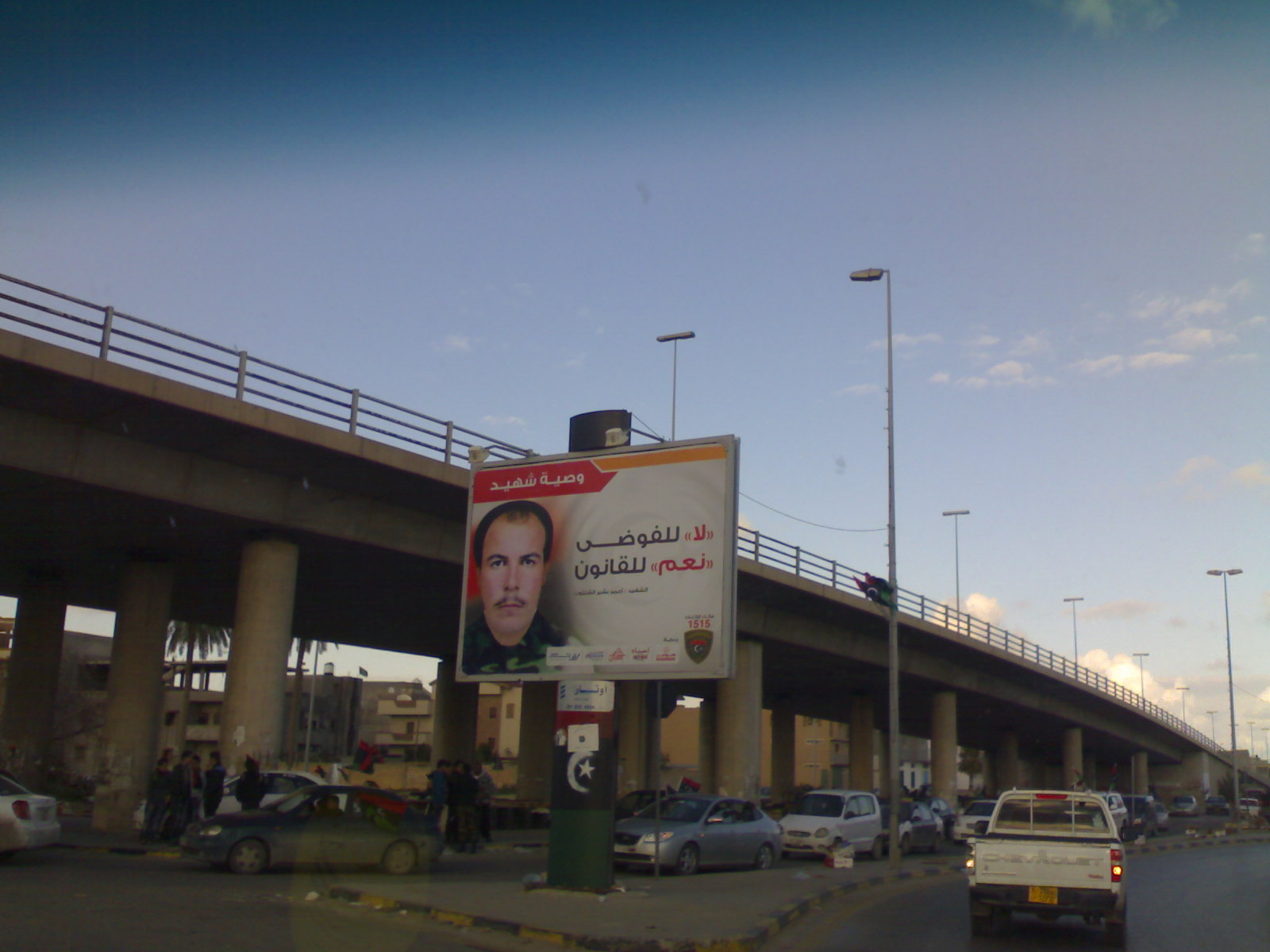
A poster of a Shaheed-Martyr at Bab Tajora area where the regime positioned

armored vehicles, took videos of protests and even attacked using ambulances

to carry mercenaries to attack the people.

Revising the meaning of “Murderer”

Was wondering about this meaning of “Murderer” as asked by Count Leo Tolstoy

In another pamphlet, entitled “How many Men are Necessary to Change a Crime into a Virtue?” he says: “One man may not kill. If he kills a fellow-creature, he is a murderer. If two, ten, a hundred men do so, they, too, are murderers. But a government or a nation may kill as many men as it chooses, and that will not be murder, but a great and noble action. Only gather the people together on a large scale, and a battle of ten thousand men becomes an innocent action. But precisely how many people must there be to make it so?–that is the question. One man cannot plunder and pillage, but a whole nation can. But precisely how many are needed to make it permissible? Why is it that one man, ten, a hundred, may not break the law of God, but a great number may?”

Tolstoy, Leo.The Kingdom of God is Within You.

Now we can speak freely, but are still waiting for someone responsible to listen
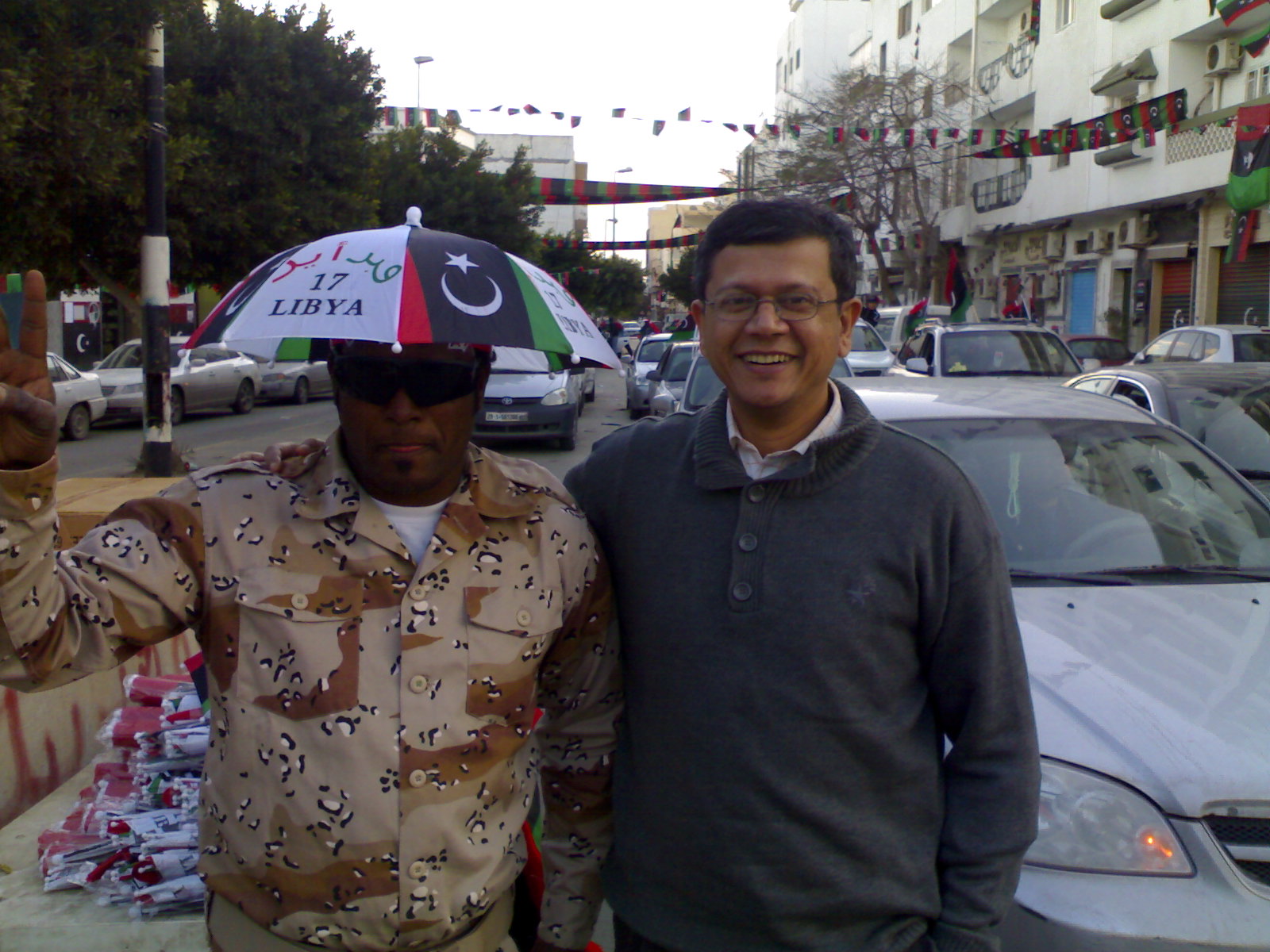
Hopeful and Happy..But there is a long way to go.

After around 100,000 people losing their lives, sacrifices which common Libyans readily gave there is still no responsible authority which can deliver.

But everyone is happy and hopeful.

Posted in Arab Spring-Libya, life | Tagged , , , | 12 Comments

What is self-esteem in your experience?

Over the past fortnight I observed some group meditations in Malta.

We have a reading group in Tripoli in which we discuss some of our common

issues within the context of changes in current Libyan society while using

some interesting readings to shape our perspective.

The Indian community centre in San Gjwann Malta holds weekly joint

meditations and group prayers.

The group meditation effort had an interactive component which

reminded me of the Mass Observation efforts.

Mass Observation Anthology was started by Tom Harrison and a

heterogeneous group of middle-class leftish intellectuals in 1937

in Davenport, Bolton.

Anthology of “Ourselves”

The valley between Swieqi and San Gjwann.. On the way to the Indian Community Centre, Malta


The original Mass-Observation group’s aim was to produced an

“anthropology of ourselves”, to discover how people really felt and

behaved at work and play.

The responses to the group coordinator’s question –

What is self-esteem in your experience, evoked some interesting responses

Are we repeating the same things?

Most of the responses were on the lines of self esteem

is being comfortable with oneself, being able to see the dark

and light side of things in a non-judgmental manner, not being

over-critical of oneself, not being shy and overcoming my inhibitions.

To this one experienced person said, when her turn came..

We are almost repeating the same thing , so I have nothing different to add.

A slightly different response

There were two responses which were different

Acceptance as self-esteem

What one wanted from life is not always what one needs.

There is a process of realization in the acceptance of what you are.

If one is comfortable in one’s socks, then it is alright.

This for me is part of a process of self-esteem

Partnership as self-esteem

One can develop self –esteem through connections and partnerships.

Having a good life-partner is part of the process of developing self-esteem.

He may not be a prince or king. But if he respects you, he is good for you.

Being in such a partnership process is part of my self-esteem.

Brahma Yajna

Group meditations, readings, reflections and interactions can be an

interesting platform to bring out such issues.

According to Hindu philosophy- Brahma Yajna is contemplation on

the meanings of scriptures, meditation, chanting and similar disciplines,

which lift the mind from worldly thoughts and take it towards Self-realization.

Hopefully these efforts will help produce a better ‘Anthropology of Ourselves

in the context of Mediterranean region.

Posted in life | Tagged , , , | 3 Comments

Reflections on our Republic Day

As we finished our weekly multidisciplinary meeting on The Republic day of India (which is also Australia Day) I asked the meaning of “Proletariat” to one of the participants.

Being a non-native English speaker he did not know the meaning of this word.

What does Republic Day of India mean to the millions of Diaspora?

How is their experience common with proletarians? The Collins dictionary defines “proletariat” as the class of  Wage earners esp industrial workers in a capitalist society whose only possession of significant material value is their labour.In ancient Rome it referred to the lowest class of citizens.

On telling this meaning, my friend immediately identified himself as a ‘proletariat’ (with a few smiles) as he has nothing of significant material value except his labour. Maybe, on a later day, we will sit together and tease out the differences and similarities between “subalterns” and “refugees”. The turmoil in Libya in 2011 made us revisit the meanings of these words in many ways as events of cataclysmic proportions unfolded on the ground. As some of the workers who fled the conflict return, there is an interesting environment to reflect on the different dynamics in place.

Current turmoil

Firing from Bab-Al-Aziziya compound of Gaddafi. Did militarism overshadow other aspects of the movement? Will the women pay a heavier price of this than the children? As I see my friend wince and turn away from the shots being fired, the August 2011 afternoon when we went to Bab-Al-Aziziya comes back with some interesting questions

As the “NTC” coalition faces increasing challenges in Libya, the Diaspora and intellectuals watch with interest the way the different dynamics play on the ground.

The relations between the various components on the “power-level” are in a state of great flux. What will be the attitude of the current persons in power to persons who want to peacefully express their opinions, will be a key to the future.

There is a churning going on in the inner depths of this society.

Educational institutions and women power at home are two areas where these will play out in a significant manner.

In his essay- “The Prophet and the Proletariat” Chris Harman talks about the ideological somersaults the Islamist leaders take whenever they get close to power.

“ They counterpose “Islamic” to “Western” values. But most so called Western values are not rooted in some mythical European culture but arise out of the development of capitalism over the last two centuries. Thus a century and a half ago the dominant attitude among the English middle class to sexuality was remarkable similar to that preached by the Islamic revivalists today (sex outside marriage was forbidden, women were not supposed to bare even their ankles. Illegitimacy was a taint people could not live down), and women had fewer rights than most versions of Islam grant them today (inheritance was to the eldest son only, while Islam gives the daughter half the son’s portion, there was no right at all to divorce, while Islam grants women that righ in very restricted circumstances). What changed English attitudes was not something inbuilt into the Western psyche or any alleged “Judeo-Christian values” but the impact of developing capitalism –the way in which its need for women’s labour power forces it to change certain attitudes and, more importantly, put women in a situation where they could demand even greater changes” (http://www.marxists.de/religion/harman/pt09.htm)

Another interesting work the famous essay on Chaplin “The Poor and the Proletariat” in which Roland Barthes argues that the Poor Man essayed by the legendary comedian is successful precisely because this character “is always just below political awareness…still outside the Revolution.”

https://prashantbhatt.com/2011/02/06/different-meanings-same-words/

An End-Note

In the coming week, maybe my reading group friend will ask a few

Women colleagues in this society, the meaning of “Proletariat”

Posted in life | Tagged , , , , | 6 Comments